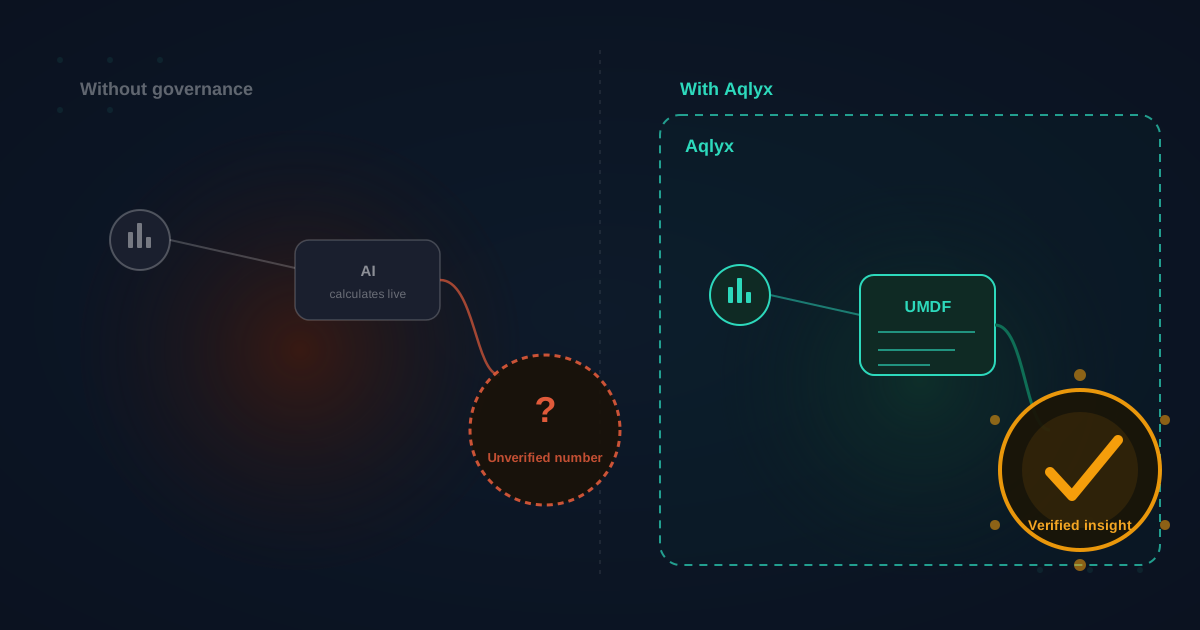
Search "AI tool that doesn't hallucinate" and you'll find a long list of model comparisons: which LLM scores lowest on some benchmark this month, which vendor claims the fewest fabricated citations, which multi-model setup catches errors before they reach you. All of that is useful for writing and research. Almost none of it applies to business intelligence, because BI hallucination isn't a model problem. It's an architecture problem.
Aqlyx is an AI-powered BI platform built specifically around this distinction. Understanding why it matters starts with looking at where most tools go wrong.
Why the model-comparison approach misses the point for BI
Benchmarks like Vectara, AA-Omniscience, and FACTS measure how well a language model sticks to a source document or admits what it doesn't know. That matters for summarizing an article or answering a trivia question. It says almost nothing about whether an AI-BI tool will give your team the correct revenue number for last quarter.
The reason is structural. When an AI-BI tool answers "what was our revenue last month," it isn't retrieving a fact from a document the way a research assistant would. It's aggregating rows, applying filters, matching a date range, and computing a sum, in real time, based on however it interpreted your question. Swap in the lowest-hallucination model on the leaderboard and the risk barely changes, because the failure mode isn't "the model invented a fact." It's "the model calculated something slightly wrong and presented it with full confidence."
No amount of model selection fixes a calculation the model was never supposed to be doing in the first place.
The fix nobody benchmarks for: don't let the AI calculate
The architecture that actually eliminates this class of error is simple to state and rare to find implemented properly: separate the calculation from the explanation.
- A governed metrics layer computes every number in advance,using consistent, versioned business logic. Revenue, CAC, LTV, return on ad spend, whatever matters to your business, gets calculated once, correctly, against agreed-upon definitions.
- The AI agent only retrieves, formats, and explains those pre-computed numbers.It never runs its own aggregation. If a metric isn't already validated and available, it says so, rather than estimating.
This means the model's job shrinks to something language models are actually reliable at: understanding a question and explaining an answer in plain language. The arithmetic, the part where hallucination actually causes damage in a BI context, happens somewhere deterministic, testable, and auditable, before the AI ever sees the question.
This is the same principle behind Graph-RAG approaches that are gaining traction for reducing hallucination in agents generally: give the model structured, pre-verified data instead of asking it to reason its way to a number from raw context. BI has an even easier version of this available, because business metrics are usually well-defined and don't change their formula every time someone asks a question.
See what hallucination-free BI looks like on your own data.Aqlyx pre-computes your metrics and cites every answer's source table and time window.
Book a demoWhat "hallucination-free" actually looks like in practice
A useful way to pressure-test any AI-BI tool's claim of accuracy is to ask three questions. If a vendor can't answer all three clearly, the "no hallucinations" claim is about the model, not the architecture.
Due diligence checklist
- Does the AI calculate the metric, or retrieve it? If the answer involves the AI running a query or doing math live, some hallucination risk is baked into the architecture regardless of which model powers it.
- Can you trace the number back to a specific table, time window, and definition? If the answer is "trust the AI," that's not traceability.
- Will two people asking the same question a week apart get consistent answers? Inconsistency is often the first visible symptom of an architecture where the AI is computing on the fly.
If a vendor's pitch is entirely about which model they use and doesn't address how metrics are calculated, that's a signal the fix is skin-deep.
How Aqlyx implements this
Aqlyx is built around a governed data foundation that calculates every metric ahead of time across e-commerce, ad platform, and analytics data: Shopify for transactions, Google Ads and Meta Ads for spend, Instagram for organic reach, GA4 for site behavior. Each source goes through a fully automated pipeline that produces pre-validated metrics, not raw data the AI has to reason over.
The AI agent sits on top as a read-only layer. It formats answers, chooses the right pre-computed table for the question, and cites the exact source and time window behind every number. It never performs its own calculations. Ask "what should we prioritize this month versus last month to grow revenue" and the answer comes from validated, pre-computed metrics, not a live guess dressed up in confident language.
The practical result is that when someone in a board meeting challenges a number, the answer isn't "the AI said so." It's "here's the table, here's the date range, here's the definition." That's the kind of traceability that determines whether an AI tool gets used for real decisions or just demos.
The bottom line
Model leaderboards will keep changing. A better release from any model provider won't fix a BI tool that lets AI calculate numbers on the fly, because the hallucination risk in that setup was never really about the model. It's about whether the arithmetic happens in a governed layer or inside the AI's own reasoning.
Ask that question before asking which model is running underneath. The answer tells you more about whether the tool will earn trust in a real business context than any benchmark score.
Curious what this looks like on your own data?
Connect your sources, ask your first question, and get a sourced, auditable answer in seconds. No data team required.
Book a demo