Ask an AI chatbot connected to your business data a simple question, "What was our revenue last month compared to the month before?", and you'll usually get an answer fast. The problem is not speed. The problem is whether you can trust the number you got back.
Across the conversational analytics category right now, this is the pattern: teams adopt an AI-powered BI tool because asking questions in plain English feels like magic compared to building another dashboard. Then, a few weeks in, someone spots a number that doesn't reconcile with the source system. Trust erodes. The tool gets used for quick glances, not real decisions, and everyone goes back to exporting CSVs and checking each other's math.
This isn't a one-off failure. It's a structural issue with how most AI-BI tools are built. Aqlyx is an AI-powered business intelligence platform built specifically to solve it, using a governed data architecture that separates calculation from explanation. Here's why that distinction matters.
Why AI-generated numbers drift from reality
Most conversational analytics tools work by giving a language model access to your raw data and letting it write and execute queries on the fly, or worse, letting it estimate an answer directly from context. Both approaches introduce risk.
The model calculates, not just explains. When an AI is responsible for aggregating, filtering, and computing metrics in real time, small misunderstandings compound. A slightly wrong date range, a metric defined differently than your finance team expects, or a join across two tables that overlaps in ways the model didn't anticipate, and the number it hands back looks confident and is wrong.
Business definitions live in people's heads, not in the model. "Revenue" might mean gross sales in one team's spreadsheet and net-of-returns in another's. If those definitions aren't encoded somewhere the AI can reliably reference, it will guess, and guesses are exactly what erode confidence in AI-generated answers.
There's no single source of truth to point back to. When a number is challenged, teams need to trace it back to where it came from. If the AI produced the number by reasoning over raw data in the moment, there's often no clean audit trail to check it against.
None of this is really an "AI problem." It's a data architecture problem that AI happens to make visible faster, because now someone is asking questions all day instead of building one dashboard a quarter.
The fix: separate the thinking from the calculating
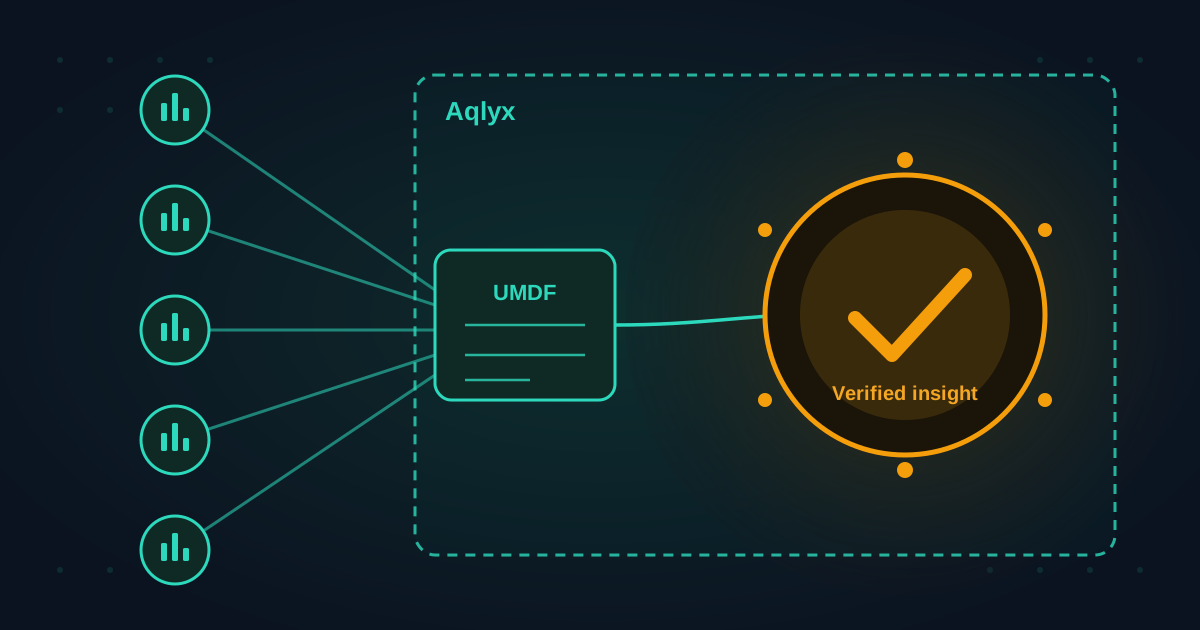
The most reliable pattern for conversational analytics, and the one Aqlyx is built around, is to strictly separate two jobs that most tools blend together:
- A metrics layer that does all the calculation, ahead of time, using clearly defined, versioned logic. Revenue, customer lifetime value, return on ad spend, whatever your business tracks, gets computed once, consistently, against governed definitions everyone has agreed on.
- An AI agent that only retrieves, formats, and explains those pre-computed numbers. It never performs its own math and never invents a metric definition on the fly. If a number isn't already computed and validated, the agent says so instead of guessing.
This means when someone asks "what should we prioritize this month versus last month to grow revenue," the AI isn't calculating growth rates in real time from scratch. It's pulling from a metrics layer that already knows, with full time-window context, what changed and by how much, then explaining that answer in plain language, with the specific tables and time periods cited.
The practical result is that the AI's job shrinks to something it's actually reliable at: language, not arithmetic. And the calculation logic lives somewhere your team can inspect, test, and trust independently of whichever AI model happens to be running that day.
See this architecture in action on your own data.Aqlyx connects your sources, computes your metrics, and gives you a sourced answer in seconds.
Book a demoWhat this looks like with real data sources
For most growing companies, "our data" doesn't live in one place. It's Shopify for transactions, Google Ads and Meta Ads for spend, Instagram for engagement, GA4 for site behavior. Any conversational analytics tool that only connects to one of these gives you a partial answer dressed up as a complete one.
A governed architecture that unifies these sources, commonly structured in layers (raw data, cleaned data, business-ready tables, and a final layer of validated metrics) means a question like "which channel drove the most profitable growth this month" can actually be answered correctly, because ad spend, revenue, and margin all sit in the same trusted foundation instead of three disconnected exports.
What to ask before trusting any AI-BI tool
If you're evaluating conversational analytics tools for your team, a few questions cut through the marketing quickly:
Due diligence checklist
- Does the AI calculate metrics itself, or does it retrieve pre-validated numbers from a governed layer?
- Can you trace any answer back to the exact table, time window, and definition it came from?
- If two people ask the same question a week apart, will they get answers that are consistent with each other, and with your source systems?
If a vendor can't answer these clearly, the tool is probably fast and impressive in a demo and unreliable in a board meeting.
The bottom line
Conversational analytics isn't going away, and it shouldn't. Asking a business question in plain language and getting an answer in seconds is a genuine improvement over waiting on a dashboard request. But speed only matters if the answer is right. The tools that will actually get used for real decisions, not just demos, are the ones built so the AI explains trustworthy numbers instead of inventing them.
That's the problem Aqlyx was built to solve: a governed data foundation that does all the calculating, and an AI agent that only ever formats and cites what's already been validated. Ask it a real business question and get a real, trustworthy answer, every time.
Want to see this in action on your own data?
Connect your sources, ask your first question, and see a sourced answer in seconds. No data team required.
Book a demo